
SICSS
SCHOOL OF INTEGRATED
CLIMATE AND EARTH
SYSTEM SCIENCES
CLIMATE AND EARTH
SYSTEM SCIENCES
Photo: UHH/Denstorf
2 June 2026, by Manuel Weidler
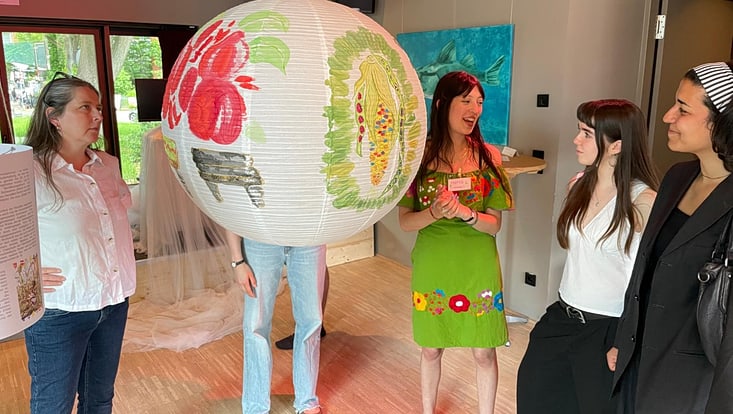
Photo: UHH/Weidler
How do we raise awareness of climate change and the biodiversity crisis when facts alone aren't enough? Four students from the Master's programme Integrated Climate System Sciences (ICSS) are testing a new approach: they want to evoke an emotional response to environmental protection. That is why they have launched a pop-up exhibition series for which they have developed works together with artists.
On this Saturday midday, the weekly market in Blankenese is bustling when unfamiliar sounds drifting out of the market hall draw visitors inside. On stage, a veiled woman dances to the rhythm of sounds from the sea. The performance by Alicja Kucewicz was one of the highlights of the opening exhibition, which drew around 200 visitors on 30 May. With her dance performance, she explores the ocean as a space in which humans are increasingly destroying the ecosystem.
"You can say we have too many greenhouse gases in the atmosphere, but to make people really start thinking, you may need to appeal to their emotions instead," says co-organiser Dagmar Coelle. The students aim to evoke this emotional response through works they created in tandem with Hamburg-based artists: the students contributed the scientific perspective, the artists the creative one.
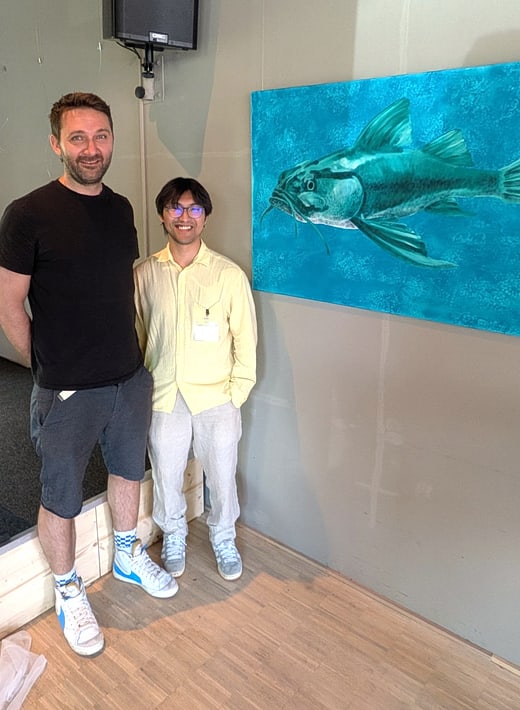
On display were works that reflect our relationship with nature under the motto "Forming Nature, Formed by Nature." Artist Sebastian Unterrainer, for example, assembled a painting of a catfish out of fingerprints — an analogy for human impact on fish in Southeast Asia. He worked together with Garmani Thway, a student from Myanmar who knows the environmental pollution there from his own experience. Other works address, for instance, urban air quality or the milpa farming system, the traditional Maya cultivation method in which squash, maize, and beans grow in symbiosis.
For the participating students, the collaboration with the artists was also scientifically rewarding: "When I saw what Marla could make of the topic, it opened up new perspectives for me: I was inspired to think more creatively myself," reports Valentina Buenfil Román, who realised the milpa project together with Marla Busse.
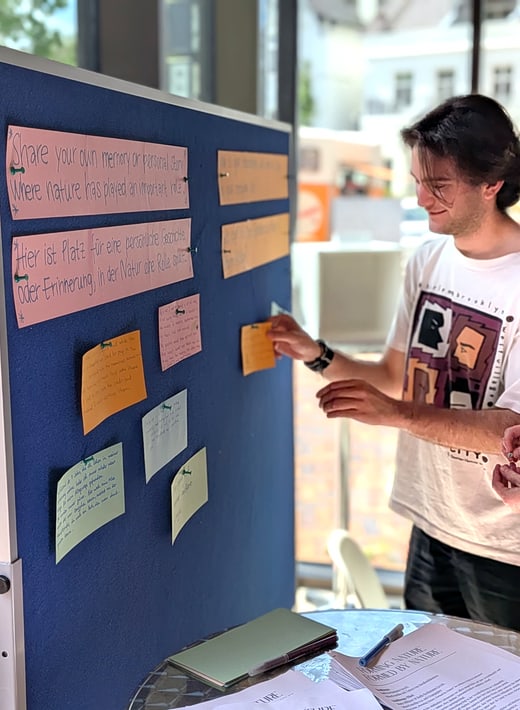
That the works prompt reflection was evident in the visitors' reactions. Many who only wanted to "take a quick look" stayed for a long time. "The branches remind me of bronchi. We are suffocating nature and ultimately ourselves," said one visitor in front of the work addressing urban air quality. Alicja Kucewicz's live performance also made an impression: one visitor reported feeling the same calm as in nature and asked herself, "Humans are nature and nature is also human. So why do we destroy the nature around us?" Visitors could record their thoughts directly on site on pinboards.
The exhibition series is funded by the Cluster of Excellence CLICCS and is part of a growing approach to bringing climate research into society through artistic formats. It is also supported by the Leibniz Institute for the Analysis of Biodiversity Change (LIB), the Claussen-Simon-Stiftung, the Alfred Toepfer Stiftung F.V.S., and NUE from the proceeds of BINGO!—Die Umweltlotterie.
The next exhibitions will take place: on 6 June at Haus 3 (Altona), on 16 June at the Honigfabrik (Wilhelmsburg), and on 11 July at Haus 73 (Sternschanze).

