• Zur Metanavigation
  • Zur Hauptnavigation
  • Zur Suche
  • Zum Inhalt
  • Zur Subnavigation
  • Zum Seitenfuß
  • University of Hamburg
  • For journalists
  • Staff Service Portal0
  • STiNE
https://www.kus.uni-hamburg.de/aktuelles.json?recentnews=true
  • Institutions and target groups
    • Einrichtungen
      • Faculties

        • Faculty of Law
        • Faculty of Business, Economics and Social Sciences
        • Faculty of Medicine
        • Faculty of Education
        • Faculty of Humanities
        • Faculty of Mathematics, Informatics and Natural Sciences
        • Faculty of Psychology and Human Movement Science
        • University of Hamburg Business School
      • Services

        • Study Information Net STiNE
        • Surfmail
        • Exchange
        • Staff Service Portal
        • Learning Platforms
        • Katalogplus – Catalogue of Hamburg Libraries
        • SharePoint
      • Student facilities and services

        • Campus Center
        • Career Center
        • PIASTA
        • AStA (student council)
        • University Sports
        • University Music
        • Family Office
        • University Language Center
        • General Languages
        • Office of Affairs for Students with Disabilities or Chronic Diseases
        • Departmental libraries
        • Healthy Campus
      • Further facilities and services

        • The Cluster of Excellence CLICCS
        • The Cluster of Excellence CUI
        • The Cluster of Excellence Quantum Universe
        • The Cluster of Excellence Understanding Written Artefacts
        • Hamburg Research Academy
        • Pier Plus
        • Hamburg Center for University Teaching and Learning (HUL)
        • Hub for Crossdisciplinary Learning (HCL)
        • CEN
        • Museums and collections
        • University Archives (in German)
        • Regional Computing Center (RRZ)
        • University Administration
        • Knowledge Exchange Agency
        • The Unikontor Shop (in German)
    • Target groups

      • Prospective students
      • Students
      • International prospective students
      • Young researchers
      • Researchers
      • Instructors
      • Staff
      • Prospective continuing education students
      • Alumni
      • Journalists
      • Refugees (in German only)
    Close
  • /sitemap.json
University of Hamburg - to research, to teach, to educate and form, to homepage

SICSS

SCHOOL OF INTEGRATED
CLIMATE AND EARTH
SYSTEM SCIENCES
  • About
    • Integrated Climate and Earth System Sciences
    • Scientific network
    • Team
    • Directions
  • Master
  • Doctorate
    • Become a member
    • Why choose SICSS?
    • Courses and Retreats
    • Supervision
    • Doctoral Researchers
    • Doctoral Representatives
    • Campus Life
    • Incoming international doctoral researchers
    • Mobility
    • Funding
  • Postdoc
    • Offers for ESRAH members
    • Offers for CLICCS members
    • Postdoc Representatives
    • Habilitation
    • Offers at UHH
    • National Postdoc Networks
  • Alumni
    • MSc ICSS Alumni
    • Doctoral Alumni
    • Our global Alumni-network
    • Alumni Registration
  • Service
    • Conflict Prevention and Resolution
    • Healthy working
    • Facilities
    • Job sites and offers from other institutions
    • MySICSS (internal)

Photo: UHH/SICSS

  1. UHH
  2. SICSS
  3. Doctorate
  4. Why choose SICSS?

Why choose SICSS?

Are you ready to take your doctoral journey to the next level? Our structured doctoral program, designed to support and facilitate your doctoral experience every step of the way.

  • Dynamic Networking: Connect with fellow doctoral researchers and other researchers from diverse scientific backgrounds, fostering interdisciplinary collaboration and innovation.
  • Career Development: Whether you're preparing for your doctorate or planning your next career move, we're here to support you in navigating your current career phase and beyond.
  • Interdisciplinary Education: Collaborate with peers and mentors to strengthen your research skills and broaden your academic horizons.
  • International Opportunities: Enhance your academic profile and broaden your horizons with opportunities for internationalization and mobility, opening doors to global research networks and collaborations.
  • Long-Term Success: Whether your path leads to academia or alternative career paths, our program is designed to facilitate your long-term success and achievements.
  • Timely Completion: Our program is structured to ensure that you successfully complete your doctorate within 3 to 4 years, providing the necessary support and resources along the way.

Expand your horizons and build lasting connections through our structured doctoral program. Join us today and unlock your full potential!

Our explicit offers:

  • Continuous supervision by ‘Advisory Panel System’
  • Supervision Agreement
  • Large networking platform in climate sciences
  • 12 CP system, official Transcript of Records (ToR)
  • Scientific and transferable courses to shape individual career perspectives
  • Introductory course to introduce all relevant topics of climate research within SICSS
  • Annual retreats, intercultural competencies, thematic excursions
  • Organisational support and personal advising
  • Support for individual career planning

Some facts

The SICSS Doctoral Program hosts permanently approx. 60 active researchers. Since 2008, more than 350 researchers were member at SICSS.

SICSS is interdisciplinary: doctoral researchers pursue their projects in more than 15 disciplines. Among these are the key disciplines of Earth and Climate system sciences such as Meteorology, Oceanography, Geology, Geophysics, and Biology, but also social sciences, economics, and disciplines affiliated with the humanities. Outstanding in SICSS is the co-supervision framework, which links researchers, supervisors, and co-supervisors from different institutions and faculties in Hamburg. In addition, the programme maintains a well-balanced gender distribution, reflecting its commitment to equal opportunities across disciplines.

SICSS is very international: the number of international doctoral researchers that joined SICSS has grown significantly ever since. Young talents from 50 countries have joined the SICSS Graduate School to pursue their doctorate in Hamburg with us.
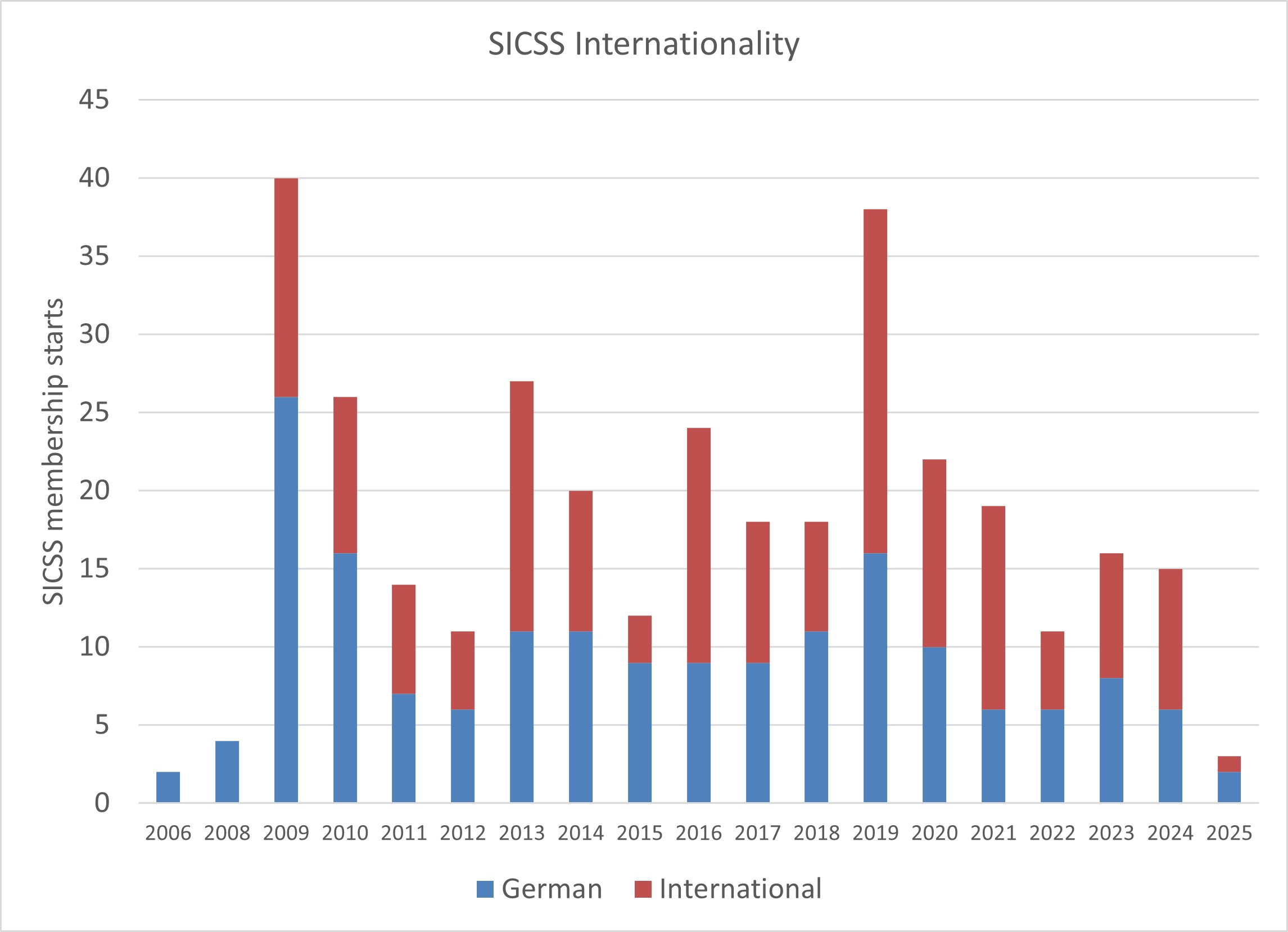
Graphics: UHH/SICSS
  • Doctorate

  • Become a member
  • Why choose SICSS?
    • Courses and Retreats
    • Supervision
    • Doctoral Researchers
    • Doctoral Representatives
    • Campus Life
    • Incoming international doctoral researchers
    • Mobility
    • Funding
    • FAQ for MIN doctoral researchers

    Important Documents

    Program Guidelines:

    • SICSS Guideline Doctoral Program (PDF)

    Membership Application:

    • Application, funded CLICCS II (PDF)
    • Application, not funded CLICCS II (PDF)
    • Application Template, not funded CLICCS II (Word)
    • Supervision agreement (PDF)
    • Photo consent (PDF)

    Advisory Panel:

    • Advisory Panel Meeting (PDF)
    • Advisory Panel Meeting (APM) report (Word)

    Membership Extension:

    • Membership Extension (PDF)

    Last update: 7 May 2026

    • Feedback
    • Legal notice
    • Privacy statement
    • Accessibility
    • Site map

    University of Hamburg

    Innovating and Cooperating for a Sustainable Future in a Digital Age

    • Follow us on Instagram.
    • Follow us on Facebook.
    • Connect with us on LinkedIn.
    • Follow us on Mastodon.
    • Follow us on Bluesky.
    • Subscribe to our channel on YouTube.
      • Studies
      • Prospective students
      • Continuing education
      • Research
      • Teaching at UHH
      • Doctoral studies
      • Job opportunities
      • Knowledge exchange
      • University
      • Excellence
      • Faculties
      • Alumni
      • Contact
      • Campus Navigator
      • UHHApp
      • Emergencies, safety and security
      • Antidiscrimination
    Go to family-friendly higher education institution audit
    Go to internationalisation re-audit
    Go to the Sustainability Audit page
    Go to Diversity Audit
    Go to System accreditation

    © 2026 University of Hamburg. All rights reserved